
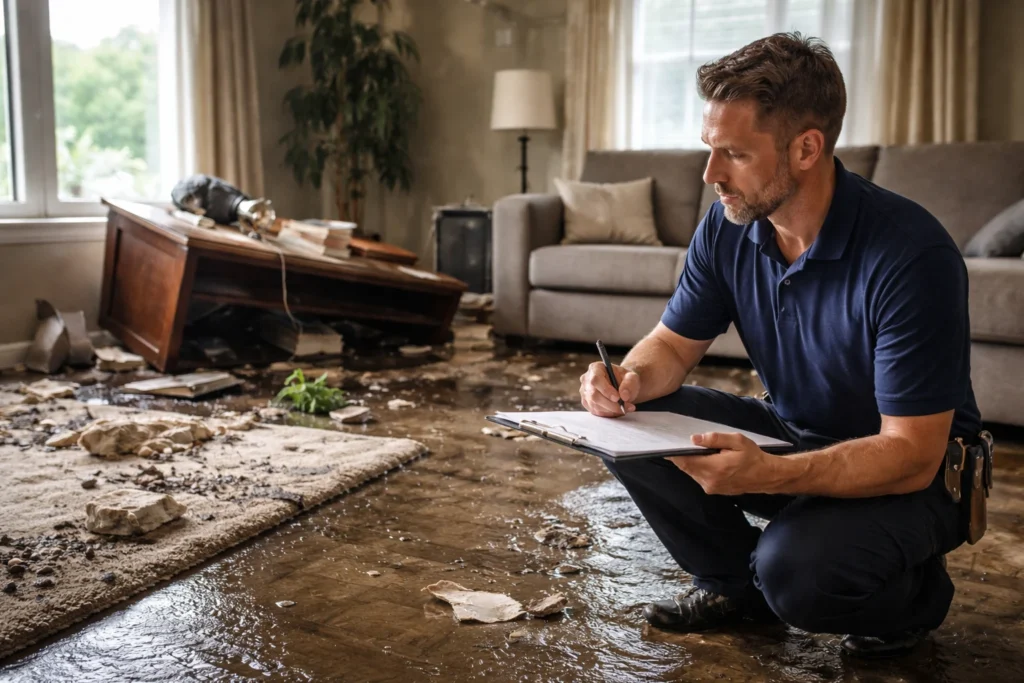
Flood damage is overwhelming. One minute everything looks normal. The next, water is creeping across floors, soaking drywall, damaging wiring, and threatening the structure of your home or commercial building. In those moments, clarity disappears fast.
This is exactly where a public adjuster for flood insurance becomes critically important.
Flood claims are not simple property claims. They are governed by strict documentation rules, policy limitations, proof-of-loss deadlines, and valuation standards that can significantly impact your final settlement. And if you accept an underpaid offer too quickly, you may never recover the difference.
Let’s break this down clearly. Step by step. So you know how to protect your claim from day one.
Why Flood Insurance Claims Are So Complicated
Flood insurance operates differently than standard homeowners coverage. It is highly structured. Highly regulated. And very specific.
Most flood policies are written through the National Flood Insurance Program (NFIP), which has firm rules about:
- What qualifies as flood damage
- What is covered vs excluded
- How proof of loss must be submitted
- How depreciation is calculated
- Deadlines that cannot be extended
If a form is incomplete or a deadline is missed, it can affect your payout permanently.
That’s why many policyholders turn to a public adjuster for flood insurance — not because they can’t file a claim, but because the financial stakes are too high to guess.
Understanding Flood Insurance Coverage
Before you even think about hiring help, you need to understand what your flood policy actually covers.
What Flood Insurance Typically Covers
Most NFIP policies include:
- Structural damage to the building
- Electrical and plumbing systems
- HVAC equipment
- Water heaters
- Permanently installed carpeting over unfinished floors
- Built-in appliances
- Foundation elements
Personal property may also be covered, but often under separate limits.
What Flood Insurance Usually Does NOT Cover
This is where policyholders get surprised.
Flood policies typically exclude:
- Temporary housing or additional living expenses
- Landscaping, fences, and outdoor property
- Mold caused by failure to mitigate
- Currency, precious metals, and important documents
- Finished basements (in many cases)
And here’s the catch: even covered items may only be paid at actual cash value (ACV), not replacement cost.
That means depreciation can significantly reduce your settlement.
A skilled public adjuster for flood insurance knows how to evaluate every line of coverage and ensure nothing is overlooked.
What Is a Public Adjuster for Flood Insurance?
Let’s clarify roles.
A public adjuster works for you — not the insurance company. They are licensed professionals who prepare, document, value, and negotiate your claim on your behalf.
Here’s how they differ:
| Role | Who They Work For | Primary Goal |
| Company Adjuster | Insurance Company | Protect insurer’s financial interest |
| Independent Adjuster | Insurance Company (contracted) | Represent insurer |
| Public Adjuster | Policyholder | Maximize policyholder settlement |
This distinction matters.
When you hire a public adjuster for flood insurance, you’re leveling the playing field.
The Flood Claim Process: What Actually Happens
Many property owners think filing a claim is straightforward. In reality, it’s procedural and time-sensitive.
Step 1: Immediate Documentation
Right after flood damage:
- Take extensive photos and videos
- Document water height lines
- Keep damaged materials
- Create a room-by-room inventory
Do not throw away items prematurely.
Step 2: Prevent Further Damage
Flood policies require mitigation. That means:
- Removing standing water
- Drying affected areas
- Preventing mold growth
Failing to mitigate can reduce your payout.
Step 3: Proof of Loss Submission
Under NFIP policies, you must submit a signed and sworn Proof of Loss within a strict deadline (often 60 days).
Miss that deadline? Your claim can be limited.
This is one of the key reasons homeowners hire a public adjuster for flood insurance — because the paperwork requirements are precise.
Where Flood Claims Go Wrong
Flood claims are frequently underpaid. Not necessarily maliciously — but often due to incomplete documentation or narrow interpretation.
Common issues include:
- Pre-existing damage disputes
- Heavy depreciation deductions
- Failure to include hidden moisture damage
- Structural damage categorized as cosmetic
- Limited scope estimates
Insurance adjusters rely on surface-level inspections in many cases. But flood damage is rarely surface-level.
Subflooring. Wall cavities. Electrical systems. Foundation movement. These are expensive repairs.
A thorough public adjuster for flood insurance investigates beyond what’s visible.
How a Public Adjuster Maximizes Your Flood Claim
This is where professional representation becomes strategic.
1. Comprehensive Damage Assessment
A public adjuster:
- Performs detailed room-by-room evaluations
- Uses moisture meters
- Identifies structural concerns
- Coordinates with contractors when necessary
Flood damage spreads silently behind walls. It doesn’t announce itself.
2. Accurate Valuation of Loss
Insurers often apply aggressive depreciation.
A public adjuster reviews:
- Age of materials
- Remaining useful life
- Replacement cost estimates
- Market pricing for materials and labor
Underestimating materials by even 10–15% can result in thousands lost.
3. Policy Interpretation
Flood policies are highly specific.
A public adjuster for flood insurance identifies:
- Coverage triggers
- Hidden limitations
- Line-item errors
- Missed building components
Small technical details matter.
4. Negotiation
Once the claim package is complete, negotiation begins.
The adjuster presents:
- Evidence-based scope of loss
- Supporting documentation
- Repair cost analysis
- Photographic proof
Professional negotiation changes outcomes.
Special Considerations for Texas Flood Claims
In areas like Cibolo and surrounding Texas communities, flood risks often combine with:
- Flash flooding
- Storm surge events
- Soil expansion and foundation movement
- Combined wind and flood losses
Texas soils shift dramatically when saturated. That means foundation stress can occur quickly.
Separating flood damage from other causes is critical.
An experienced public adjuster for flood insurance in Texas understands how to document these overlapping issues correctly.
Signs Your Flood Claim Is Being Underpaid
Not sure whether you need help? Look for these red flags:
- Settlement seems unusually low
- Large unexplained depreciation
- Important rooms missing from estimate
- No allowance for hidden damage
- Repeated requests for documentation
- Long unexplained delays
If any of these apply, it may be time to consult a public adjuster for flood insurance before accepting payment.
Remember: once you sign a release, it can be difficult to reopen the claim.
What Does It Cost to Hire a Public Adjuster?
Public adjusters typically work on a contingency fee basis.
That means:
- No upfront payment
- They are paid a percentage of the settlement
- Fees often range between 5% and 15% depending on claim size and complexity
Here’s a simplified example:
| Scenario | Without Adjuster | With Adjuster |
| Initial Offer | $65,000 | — |
| Negotiated Settlement | — | $95,000 |
| Adjuster Fee (10%) | — | $9,500 |
| Net to Policyholder | $65,000 | $85,500 |
Even after fees, the difference can be substantial.
Of course, every claim is different. But complex flood losses often justify professional representation.
When Hiring a Public Adjuster Makes the Most Sense
Not every small claim requires outside help. But in these situations, hiring a public adjuster for flood insurance is strongly worth considering:
- Structural flood damage
- Multi-room water intrusion
- Commercial property losses
- Denied flood claims
- Underpaid settlements
- Claims involving foundation issues
The larger and more complex the loss, the greater the potential benefit.
Frequently Asked Questions
Do I need a public adjuster for a small flood claim?
For minor damage, you may not. For larger structural losses, professional representation can significantly improve accuracy.
Can I hire one after filing a claim?
Yes. A public adjuster for flood insurance can step in mid-claim.
Will hiring one delay my claim?
Often the opposite. Organized documentation can streamline the process.
Are public adjusters licensed in Texas?
Yes. They must be licensed and regulated.
Can they reopen a closed flood claim?
In certain cases, if within allowable timelines and proper documentation exists.
How to Choose the Right Public Adjuster
Not all adjusters have flood expertise. Flood policies are specialized.
Here’s what to look for:
- Texas licensing verification
- Specific experience with NFIP flood claims
- Clear contingency fee structure
- Strong documentation process
- Transparent communication
Ask direct questions. Request examples. Verify credentials.
Flood claims are too important to leave to chance.
Final Thoughts: Protecting Your Settlement After a Flood
Flood damage is disruptive. It affects your finances, your routine, your sense of stability.
And once the water recedes, the financial process begins.
Insurance companies follow strict guidelines. You should too.
A public adjuster for flood insurance ensures that your claim is:
- Thoroughly documented
- Accurately valued
- Properly negotiated
- Fully compliant with policy requirements
If you are facing a significant flood loss in Cibolo or surrounding Texas communities, do not rush to accept the first offer. Review it carefully. Ask questions. Seek professional guidance if needed.
Because once a settlement is finalized, your opportunity to recover additional funds may be gone.
Flood damage is stressful enough. Your claim process should not add to it.
Take control early. Document everything. And if necessary, partner with a qualified public adjuster for flood insurance to protect what matters most.